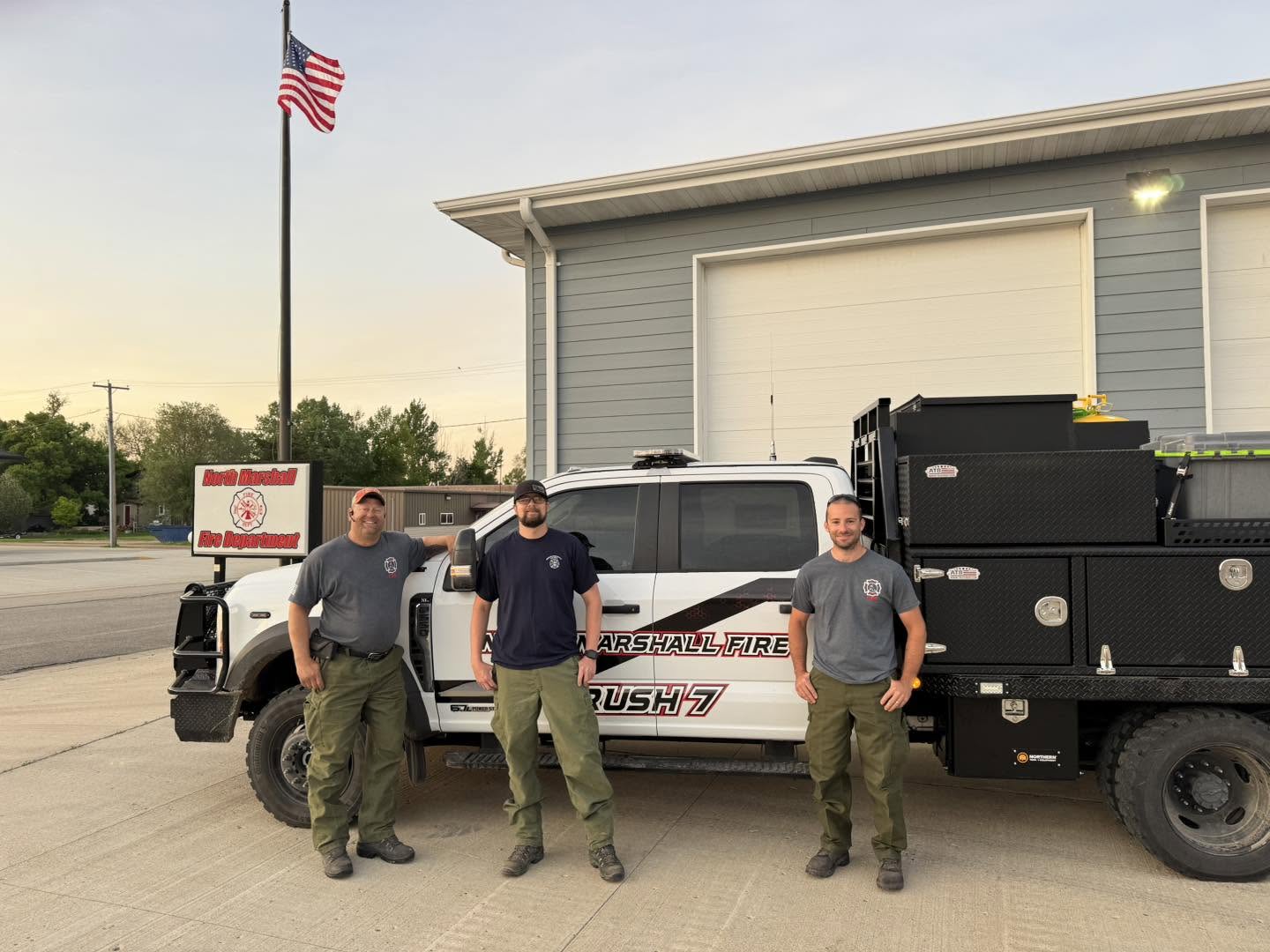
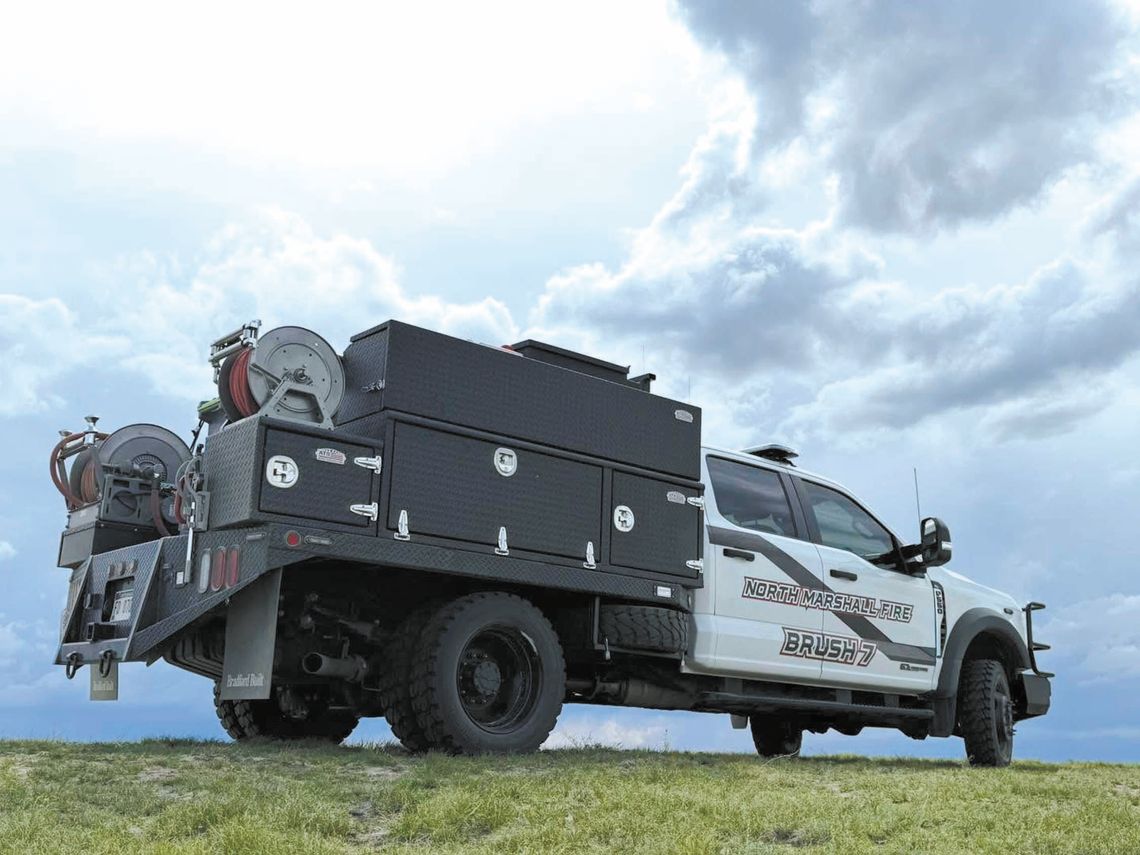
A new fire truck parked inside the North Marshall Fire Department may look like a heavy-duty pickup, but firefighters say it is one of the most capable pieces of equipment the department has ever owned.
Known as Brush 7, the department’s new Type 6 wildland fire engine was built to respond to grass and wildland fires both close to home and across the region. Designed on a Ford F-550 chassis, the four-wheel-drive truck is compact enough to travel through rough terrain while carrying specialized firefighting equipment, water and the ability to fight fire while moving.
For North Marshall Fire Chief Nate Dinger, the truck represents years of planning and a commitment to strengthening the department without placing additional costs on local taxpayers.
“The goal has always been to build up our local department and our equipment without burdening taxpayers,” Dinger said.
The idea for Brush 7 began in August 2025 when members of the North Marshall Fire Department Association learned funding through donations was available. The association voted to move forward with the project, ordering the truck on Dec. 31. Rather than purchasing a completed fire engine, department members oversaw construction locally in Britton over the next four months.
Engine Boss Tyler Cape said taking that approach saved the department more than $100,000.
“We built exactly what we wanted,” Cape said.
Cape, who has served as a firefighter for 17 years, has fought wildland fires throughout the United States. While deployed, he made a point of talking with firefighters from other agencies about the equipment they relied on.
“I’d always ask them what they liked about their trucks and what they wished was different,” he said. “We took the best ideas from all of them and put them into one truck.”
Fellow firefighter Brett Hockenbrock, a 10-year member of the department, agreed.
“It’s really a combination of everything that was best,” he said.
Although North Marshall already owned one truck dedicated to wildland fires, firefighters said one vehicle was no longer enough.
Wildland fires are unpredictable, and multiple engines are often needed to attack a fire from different sides. The department previously didn’t have enough wildland fire trucks for the amount of volunteers responding to fires or to handle complex wildland fire incidents.
The new truck features two hose reels, additional storage and highly maneuverable hose that can be deployed in places larger fire engines cannot reach.
Cape said those capabilities could make a significant difference with the hundreds of feet of hose to get water on a fire fast where getting a truck directly to the fire line isn’t possible due to terrain, vegetation, or other circumstances.
“If Brush 7 saves one home, one barn or keeps one fire from getting large, it’ll be worth it,” Cape said.
Brush 7 was officially unveiled May 26. Just two days later, it left Britton for its first assignment, helping battle the Rock Fire in the Pine Ridge area.
Since then, the truck has responded to multiple deployments in western South Dakota. Most recently, Cape said the crew spent two weeks based out of Hot Springs, assisting on three different wildland fires.
Sometimes crews are dispatched because of an active wildfire. Other times they are sent because dangerous fire weather conditions make additional resources necessary.
“Sometimes the goal is simply to keep a fire small enough,” Hockenbrock said.
The truck has even become a familiar sight outside of emergencies, taking part in the Fourth of July parade in Hot Springs while crews were stationed there.
Cape serves as the department’s qualified Engine Boss, a certification earned through years of wildfire experience, classroom training and incident management courses. The designation is required under national wildland firefighting standards to supervise a Type 6 engine crew. One of the department’s long-term goals is to train additional firefighters to earn the same certification.
Although Brush 7 was built to serve Marshall County first, it also benefits the department financially when deployed to larger incidents. Through state and federal reimbursement programs, the truck has already generated more than $50,000 since entering service.
“It’s an asset for the department, the community, the state and the federal system,” Dinger said. “It starts here.”
Once the truck is fully paid for, reimbursement funds earned on deployments will be reinvested back into the all-volunteer department for future equipment and training.
Cape said some people question whether a specialized wildland engine is necessary in northeastern South Dakota, but he believes the region’s fire risk says otherwise.
“There’s a misconception that we don’t need it,” he said. “But the wildfire potential here is high.”
For Hockenbrock, Brush 7 offers something no other vehicle in the fire hall can. “It’s the only truck in the building that can actually make money,” he said. Dinger added, “But most importantly, it’s another tool that helps us protect our community.”
Whether responding to a grass fire near Britton or assisting on large wildfires across the region, firefighters say Brush 7 is already proving to be a valuable addition to the department.