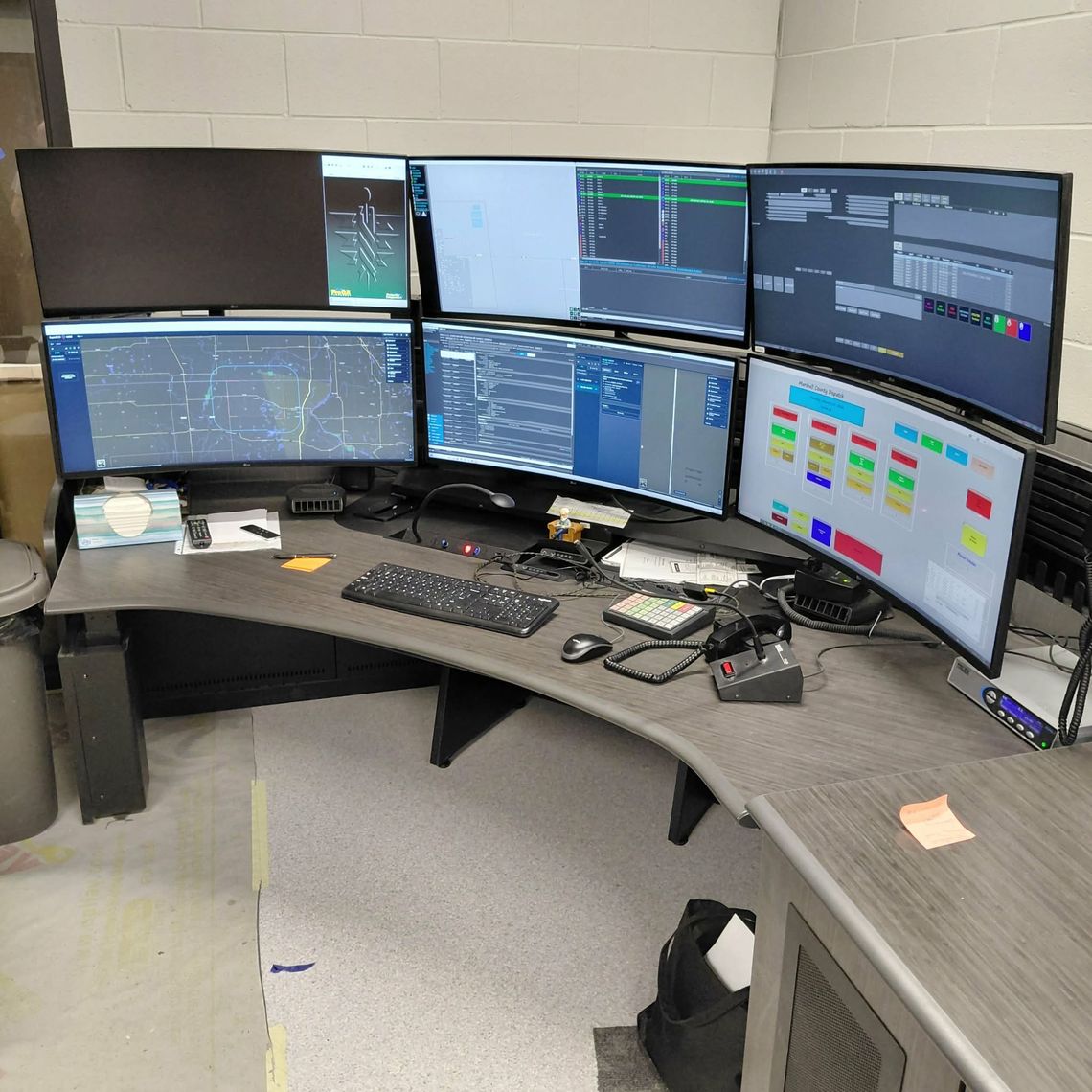
Marshall County dispatchers have been on the move lately. As work wraps up at the new Marshall County Law Enforcement Center, attached to the courthouse, careful consideration was required to move emergency services into the building in a timely and safe manner. Thanks to the assistance of a neighboring county, the transition went smoothly.
The Marshall County Sheriff’s Office and E911 Services had been housed in the county Community Building since vacating the courthouse at the start of the construction project. While staff acknowledged they were fortunate to have a temporary location, space was limited. “We were on top of each other over there,” chuckled Logan Roehr, Marshall County Emergency Management Director and a dispatcher. He noted that personnel spent 466 days operating out of the Community Building.
By late last fall, Roehr said the long-awaited move into the Law Enforcement Center was finally becoming a reality, and the timing mattered. Because the transition required assistance from the county’s state vendor, the schedule was moved up sooner than expected. “We were told we needed to do it in January, or they wouldn’t be able to do it until April or May,” said Deb Skonberg, Marshall County E911 Coordinator.
Despite the short physical distance of less than half a mile, the move raised significant concerns. The challenge was maintaining uninterrupted 911 service throughout the process. Unplugging equipment in one building and plugging it in at another was not an option, as numerous systems, connections and pieces of equipment had to remain operational.
Roehr said planning began in earnest about two months in advance. “We had to think how to mitigate as many issues as possible,” he explained.
Roehr and Skonberg outlined several possible solutions. One option involved having a neighboring county temporarily handle Marshall County’s 911 calls and relay information back. However, that approach came with drawbacks.
“We knew it would be better for the calls to stay with us,” Skonberg said. “We have that local knowledge that can be really helpful in emergency situations, like with names and locations.” Other ideas included answering calls via cell phone or landline, but those options would have limited access to the systems dispatchers rely on daily.
That led to another possibility: continuing to answer Marshall County’s 911 calls using their regular equipment, but from a temporary location outside the county.
The team began exploring that option with guidance from Jason Husby, the state 911 coordinator. Husby, whose role includes ensuring counties follow state requirements, supported the plan.
With that backing, Marshall County officials reached out to the largest nearby county they believed could help make it work: Brown County.
They approached Brown County personnel, including Communications Director Kent Jones and Assistant Communications Director Sarah Jesz. Brown County officials were receptive to the request and agreed to provide Marshall County with temporary dispatch space.
The temporary relocation to Brown County proved relatively straightforward. Skonberg explained that the state operates on a shared system, allowing Marshall County dispatchers to log in using their own credentials. In addition, some Marshall County equipment was brought along to maintain local control functions.
To simplify logistics during the short stay in Aberdeen, Skonberg and Roehr said only a limited number of local dispatchers were used, primarily those who already lived in the area or had accommodations available.
Overall, the experience was described as positive, marked by cooperation and strong camaraderie with their Brown County counterparts. “I think we all learned from each other,” Roehr said. “We do things a little differently than they do, but it was interesting to see how they operate.” Meanwhile, back in Marshall County, vendors successfully relocated and installed all dispatch equipment at the new Law Enforcement Center. After less than a week of operating outside the county, dispatchers were able to return home and resume normal operations in the new facility.
In the end, officials were pleased with how the transition unfolded. “We had zero downtime and no issues,” Roehr said, noting that the week was relatively quiet, which also helped.
Skonberg said the successful move underscored the value of statewide coordination. “I think it’s a testament to the fact that our state has done things correctly,” she said.
The successful transition highlighted the importance of regional partnerships and preparation in emergency response. By working together and using shared systems, counties were able to ensure that critical 911 services remained available at all times, even during a major change.