Emails obtained by clean-water advocates show the state of South Dakota declined $290,000 of federal funding for zebra mussel decontamination stations at Pactola Reservoir, which the advocates say is evidence that the state isn’t taking the invasive threat seriously enough.
The state agency tasked with fighting aquatic invasive species said it declined the money because it was only for equipment, without additional ongoing funding needed for the equipment’s operation and maintenance. The agency defended its approach to zebra mussels, saying it’s focused on the most practical steps it can sustain with available staff, emphasizing boat inspections and education aimed at slowing the spread.
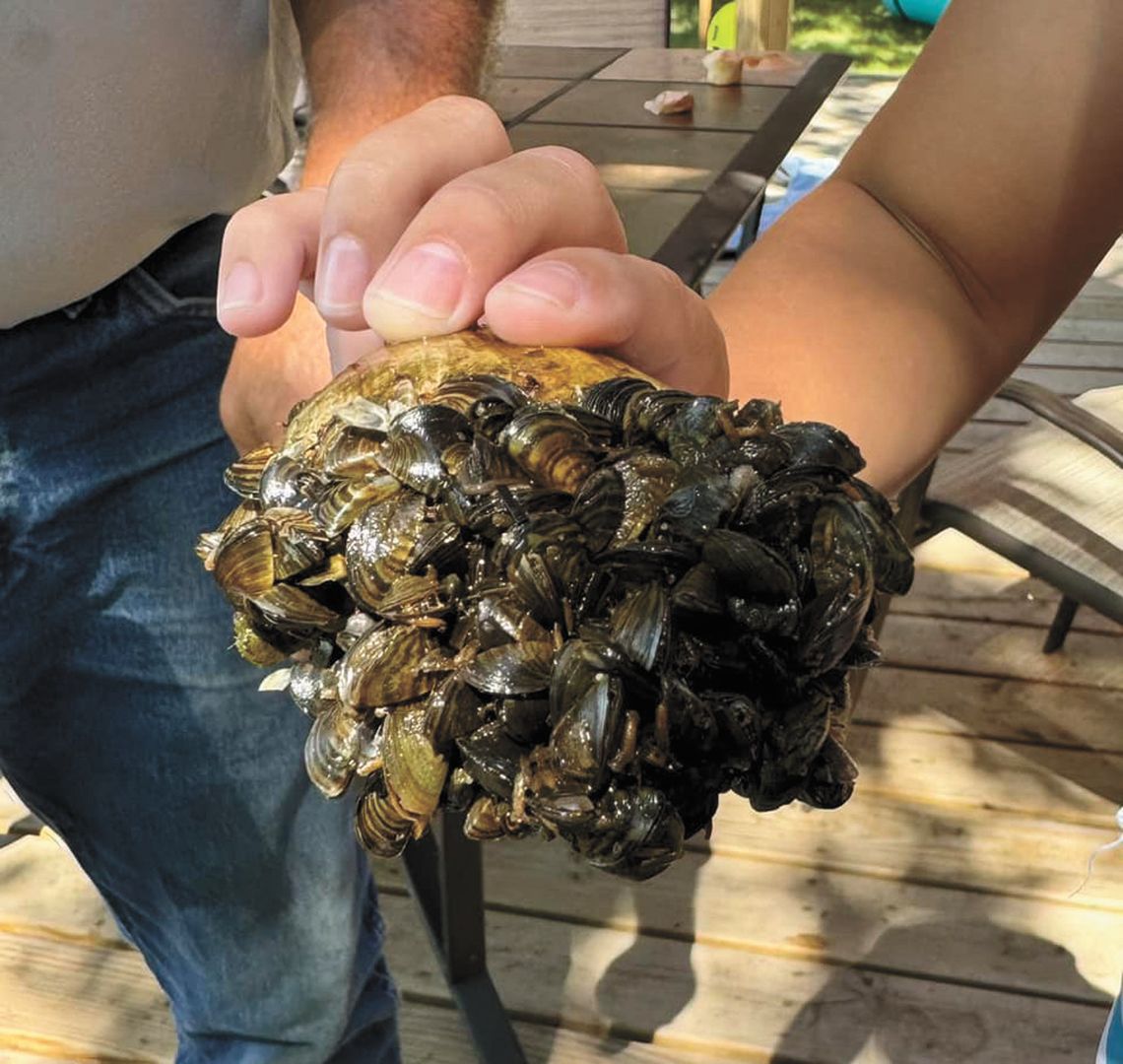
Zebra mussels are tiny invasive shellfish, originally found in Asia and Europe, that spread by clinging to boats. They clog pipes, water intakes and hydroelectric power equipment, cut swimmers’ feet, and change the native aquatic ecosystem.
The number of zebra mussel-infested lakes in South Dakota grew from one in 2014 to 32 now.
State Department of Game, Fish, and Parks Secretary Kevin Robling said while testifying to lawmakers last January that he was unaware of any missed zebra mussel funding opportunities.
“I am not familiar with any money that we reverted back or did not spend or did not use,” Robling said.
South Dakota Lakes and Streams Association board members had heard otherwise. They obtained emails, reviewed by South Dakota Searchlight, that show federal agencies and the state discussed Pactola Reservoir containment options in 2022 and 2023, and that the state ultimately declined U.S. Bureau of Reclamation funding for decontamination equipment at Pactola. The reservoir, a key Black Hills water source and recreation site, was confirmed to have zebra mussels in July 2022.
South Dakota Lakes and Streams Vice President Deb Soholt, a Republican former state senator from Sioux Falls, said the emails reflect a broader lack of urgency on the part of the state.
“We’ve made a policy decision that there’s nothing we can do to stop this, no matter how much money we pour at it,” Soholt said. “That’s a flawed premise. Other states are fighting. We should be, too.”
Game, Fish, and Parks spokesperson Nick Harrington said the agency is doing what it can.
“Our inspection numbers have continued to increase throughout the years,” he said. “If they want to say that between a certain year there was a funding lapse, well, inspections were increasing. The program was operating. The program was funded.”
He said there were 14,556 boat inspections in 2021, 18,582 in 2022, 18,642 in 2023, and 22,165 in 2024. Inspectors ensure boaters have cleaned off any plants, mud and debris, drained live wells or tanks that hold water, and dried everything completely before launching in another waterbody.
Harrington said Robling did not recall the declined funding when he was asked about it last year during a legislative hearing.
What the emails show
At Pactola Reservoir, the U.S. Bureau of Reclamation operates the dam, the U.S. Forest Service manages the surrounding land and recreation sites, and the state Department of Game, Fish, and Parks oversees fishing and boating regulations and invasive species control.
The emails show the bureau, Forest Service, and Game, Fish and Parks convened multiple meetings in July 2022 to discuss management options “for preventing the spread of zebra mussels from Pactola Reservoir to surrounding waterbodies.”
On July 19, 2022, a state employee summarized the state’s approach to zebra mussels at Pactola.
“After reviewing our current resources and limitations that exist with staff and equipment, it is very evident that there is no way we can implement a comprehensive containment approach on Pactola Reservoir,” wrote GF&P Fisheries Supervisor Jake Davis.
Davis wrote that the state would “focus on outreach and education,” adding that “inspections will still occur.”
The emails referenced decontamination units, which are hot water, high-pressure sprayers used to clean boats by killing and removing zebra mussels.
Davis said in the emails that there was already a decontamination unit at Pactola.
In February 2023, the bureau drafted Pactola Reservoir zebra mussel containment recommendations. They describe goals to educate the public and contain the spread. They also note that the bureau had secured funding “for two additional decontamination units at Pactola Reservoir.”
On March 7, 2023, the state’s fisheries program administrator informed the bureau that, “after discussion with Senior Administration,” the department did “not desire to enter into an agreement” for the $290,0000 of federal funding to purchase two additional decontamination units at Pactola.
The proposal included another $200,000 for the Forest Service to help pay for the equipment, according to emails obtained by Lakes and Streams.
“These were one-time funds, and no additional funds were going to be made available for future operation and maintenance of these pieces of equipment,” Harrington said in a statement to South Dakota Searchlight. “As a result, we requested that the funds be used to help cover the costs of labor at current inspection stations, as that is where they could be used to best support” the state’s aquatic invasive species program.
“Unfortunately, due to the way the funds were requested, their purpose could not be altered,” Harrington said.
Game, Fish and Parks spent $4.65 million to combat aquatic invasive species in the state from 2021 to 2024, with $3.7 million coming from outside the department (predominantly from federal agencies).
Harrington said the department focuses its resources on public outreach and inspections.
“Our goal is to slow the spread of these species,” he said. “Our message is clean, drain, dry.”
Harrington said compliance at inspection stations is high.
“People know the rules, and they’re following them for the most part,” he said. “Ninety-eight percent compliance is better than seat belts — and those save our lives.”
Advocates say ‘not enough’
Soholt said the compliance rate is less when no official is waiting at the shoreline to inspect a boat. She wants lawmakers to convene a public-private working group to develop a new statewide strategy, including options like seeking private donors or adding a small license fee per boat to help fund more zebra mussel containment.
“We could fiercely protect the remaining reservoirs and lakes if we acted now,” she said. “Instead, we’re saying, ‘It’s inevitable.’”
Dan Loveland, also with Lakes and Streams, said watercraft inspections are the most effective tool, and South Dakota’s inspection effort is weak and under-resourced. He said “clean, drain, dry” isn’t enough without enforcement to back it up.
Loveland, too, wants a statewide stakeholder process and a dedicated funding source to fight aquatic invasive species.
“Get all these stakeholders together and go through what is happening to our state, and let’s talk about different ways that we can approach this,” he said. “Let’s find a funding source that we can dedicate to fighting the aquatic invasive species all across South Dakota.”
Robling gave a presentation to lawmakers on Thursday that included information on zebra mussels. He showed lawmakers a time-lapse map of the species’ spread since the late 1980s to underscore that South Dakota is not alone.
Asked about research, Robling said genetic approaches aimed at reducing zebra mussel reproduction are still in early stages and have seen “very little success” so far, though Minnesota remains a research hub.
Rep. Tim Goodwin, R-Rapid City, said he plans to propose a legislative summer study on zebra mussels.