
Go to main contentsGo to main menu
Friday, October 30, 2026 at 10:16 AM

4-HERS HELP WITH NATIVE PRAIRIE SERVICE PROJECT

4-HERS HELP WITH NATIVE PRAIRIE SERVICE PROJECT
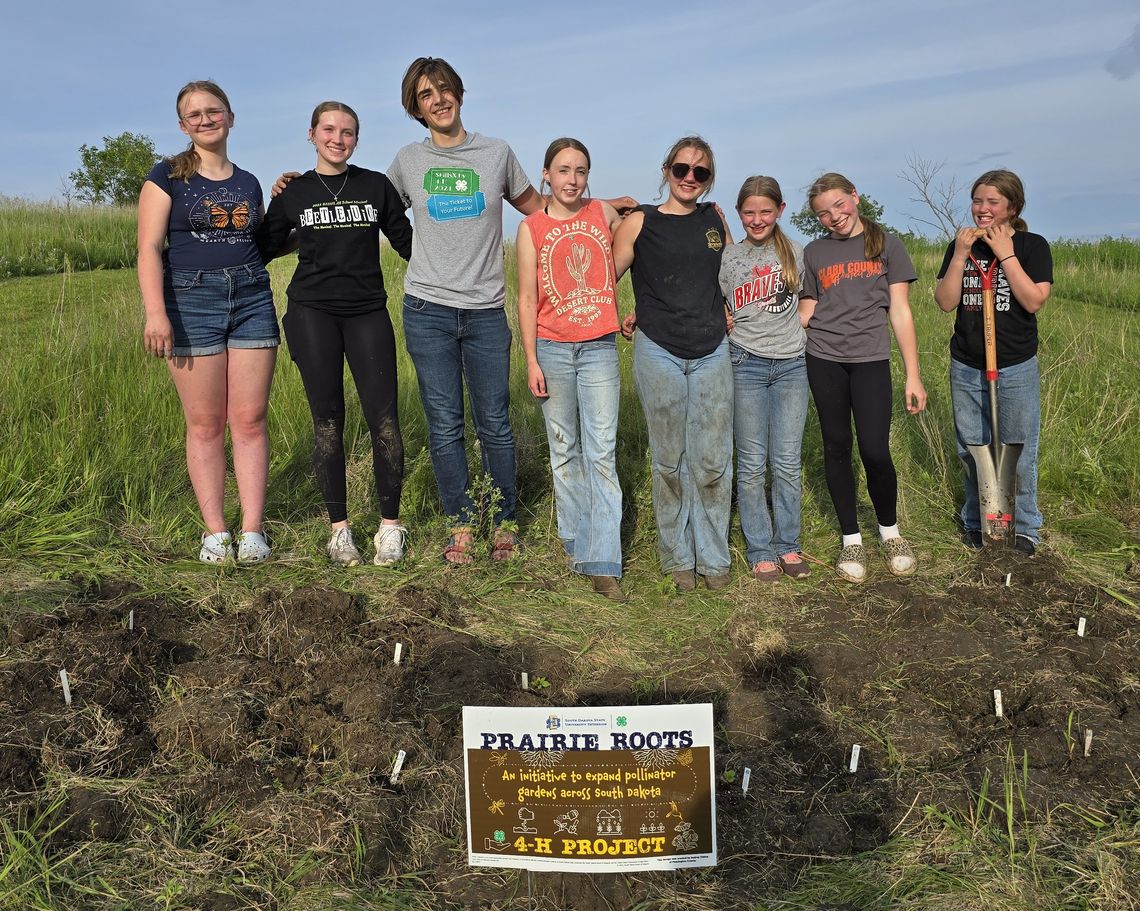
These 4-Hers helped with the Prairie Roots initiative by planting native plants at Fort Sisseton recently. Left to right-Luzetta Moeckly, Emily Effling, Oliver Moeckly, Kaylee Carlson, Baylee Bender, Skylar Bender, Riley Van Lith, Rhyker Bender. Not pictured but also helped plant: Sophie Patterson, Aleece Patterson, Eliana Satterlee.

    This year, several Marshall County 4-H members joined a statewide effort to improve South Dakota’s natural landscape through the 4-H Prairie Roots community service project. The annual project, selected by State 4-H Ambassadors during the SkillsX by 4-H event, focuses on replacing invasive grasses with native plants to support ecological diversity.
    In Marshall County, 4-H participants—Luzetta Moeckly, Emily Effling, Oliver Moeckly, Kaylee Carlson, Baylee Bender, Skylar Bender, Riley Van Lith, Rhyker Bender, Sophie Patterson, Aleece Patterson, and Eliana Satterlee—planted 200 square feet of native grasses, flowers, and other plants at Fort Sisseton State Park. The planting is located along the mowed walking trails on the northwest side of the park, past the cemetery.
    Oliver Moeckly represented Marshall County as a State 4-H Ambassador and helped coordinate the project statewide. 
    The Prairie Roots initiative aims to enhance habitat for local plant and animal life across South Dakota, making a lasting impact on the state’s environment.


Share
Rate

Poll: REGIONS FOR AMBULANCE SERVICE? A legislative task force is considering a plan to organize South Dakota’s ambulance services into eight to 14 regions, potentially with state oversight and funding to help keep emergency medical services sustainable. The proposal comes as many ambulance services face financial challenges, low reimbursement rates and an aging, often volunteer workforce. Lawmakers say the goal is to ensure an ambulance can respond when someone calls 911, but establishing the regions and determining how they would be funded could take years. Do you support creating regional ambulance service systems with state oversight and potential state funding?
READ OUR E-EDITION